How to recognise counterfeit peptides: 8 signs
Counterfeit peptides are a serious problem. Check the price, certificate, packaging and the supplier's communication, and learn to recognise the red flags.
Key findings
- The most common red flags are a price that does not cover quality and documentation without a batch number.
- A hologram or attractive packaging is not proof of authenticity.
- Independent analysis of the purchased batch is the strongest verification.
- A good supplier answers technical questions and does not promise therapeutic effects.
The peptide market is large, poorly regulated and attractive to counterfeiters. Because most buyers do not have a laboratory at home, trust often depends on packaging, a website and a few photographs.
This article describes eight signs that should raise suspicion. None is absolute proof, but a combination of several is a serious signal.
1. A price that does not hold up economically
Synthesising a peptide, purification, analysis, packaging and the cold chain all cost money. If the price is significantly below average, it is possible that:
- the quantity is smaller than stated;
- the purity is not as stated;
- it is a different molecule;
- no analysis was performed;
- savings are being made on storage and transport.
Cheap is not always bad, but it demands additional verification.
2. A COA without a batch number
A certificate of analysis must be linked to a specific batch. If it contains only the product name and “99 %”, it proves nothing about the vial in your hands.
Check whether the batch number on the vial matches the number in the document. If it does not, ask why.
3. Generic labels and typing errors
Counterfeit products often use:
- a generic label without a manufacturer;
- a misspelled peptide name;
- incomplete units (mg, µg, mL);
- an unclear statement of form (powder, solution);
- a missing batch number or expiry date;
- poor print quality and curled edges.
None of these defects is fatal in itself, but several together point to negligence or a counterfeit.
4. Unclear origin
A good supplier can answer:
- who the manufacturer or filler is;
- where the batch was produced;
- who performed the analysis;
- how the supply chain worked.
If the answers are vague, generic or change, that is a warning. “Russian peptides” can be a legitimate label of origin, but it must be supported by documentation.
5. Mismatch between appearance and mass
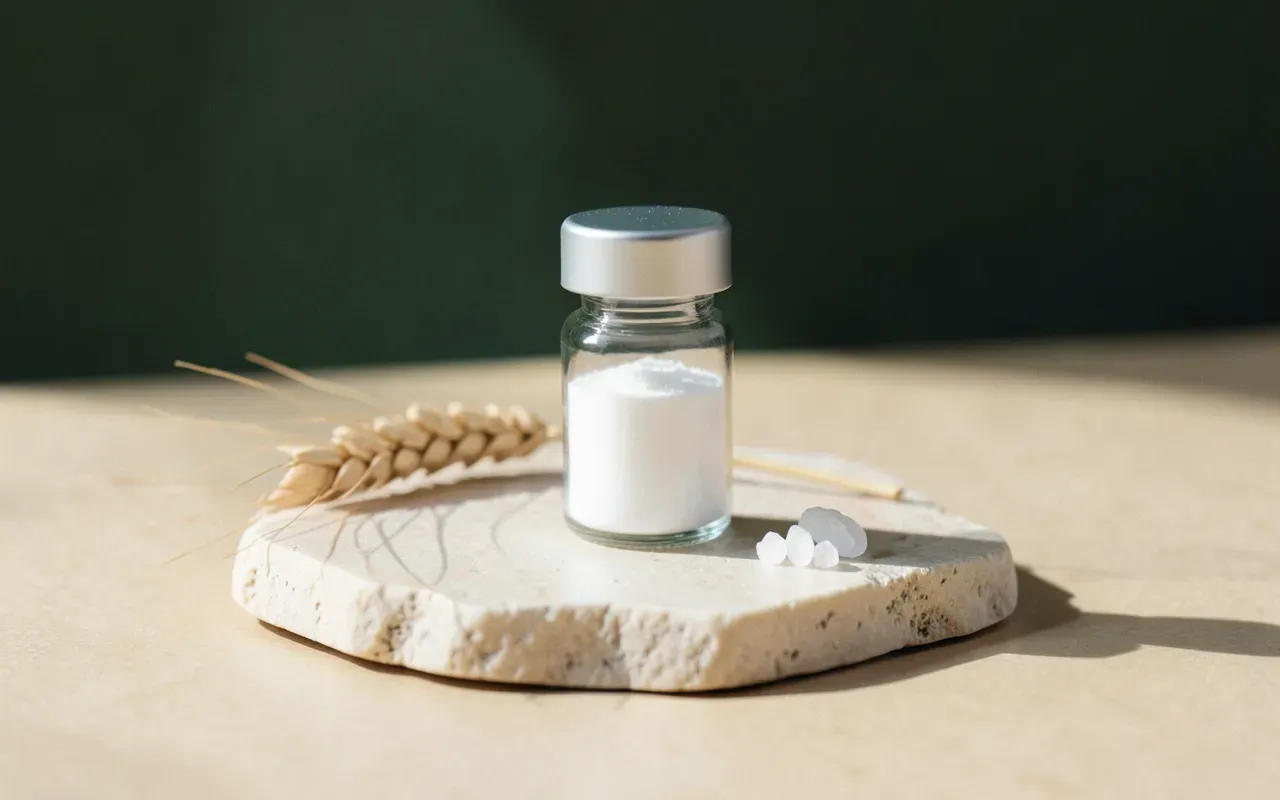
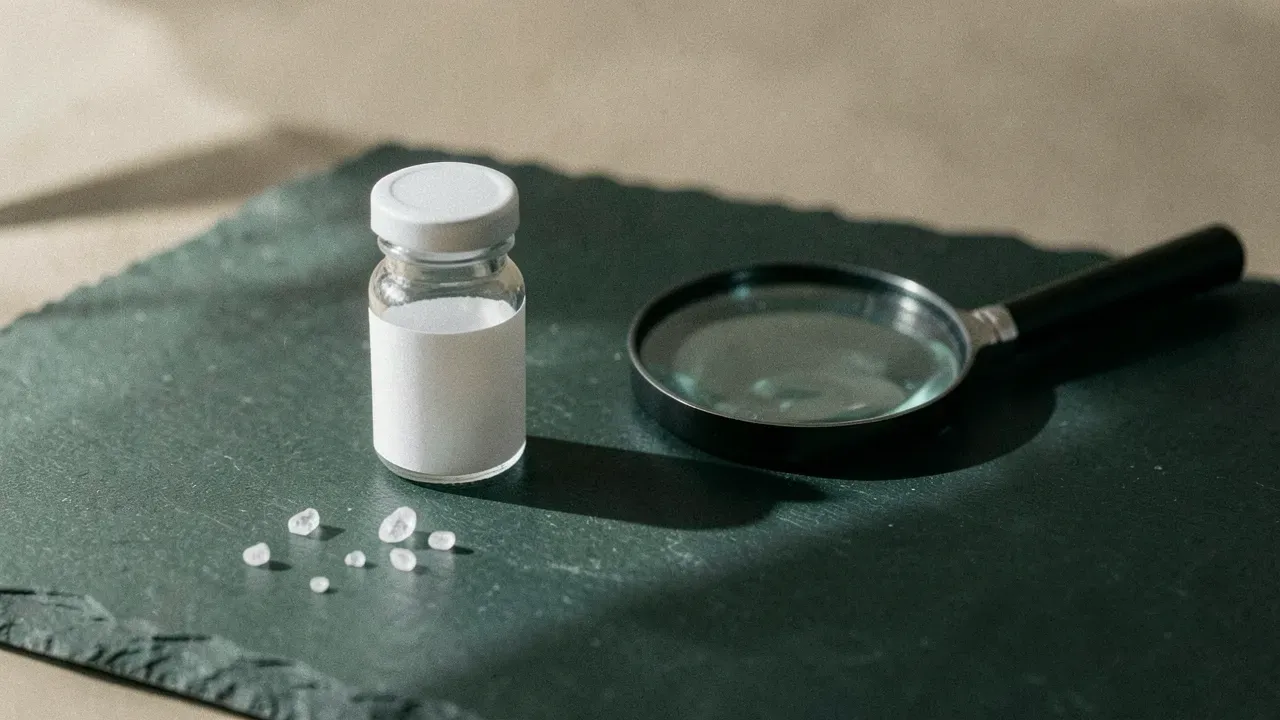
A lyophilised peptide is usually a white to almost white foamy substance. Deviations are possible, but:
- discolouration (yellow, brown) may indicate degradation or impurities;
- a sticky or damp mass indicates moisture;
- too little powder relative to the stated mass is suspicious;
- particles or sediment in the solution indicate dissolution problems or contamination.
Appearance is not proof of identity, but it is a useful screening.
6. Fake evidence and reviews
The peptide market commonly features:
- fabricated reviews;
- photographs copied from other sites;
- “laboratory results” without a laboratory;
- citations of studies that do not support the claim;
- accreditation logos without a link.
Check whether the laboratory is real and whether its accreditation can be found. Read what the study actually measures.
7. Lack of storage and expiry information
Peptides are sensitive. A serious supplier states:
- the storage temperature;
- protection from light and moisture;
- the expiry date;
- the conditions after reconstitution;
- any transport restrictions.
If this information is missing, the product has probably not been handled as a material under quality control. What we recommend after reconstitution is described in the guide to storage and reconstitution.
8. Communication that promises too much
If the seller:
- promises treatment of disease;
- states “100 % safety”;
- recommends doses for humans;
- claims that there are “no side effects”;
- pressures for a quick purchase;
…then this is not a scientifically oriented supplier. For research products, the appropriate questions are technical: purity, method, batch, stability.
What to check before purchase?
| Element | What to require |
|---|---|
| Identity | Exact name, sequence and molecular mass |
| Purity | HPLC with method and chromatogram |
| Identity (MS) | Measured and expected mass |
| Traceability | Batch number on the vial and in the COA |
| Content | Data on water and salt, where relevant |
| Storage | Clear instructions and expiry date |
| Laboratory | Name and any accreditation |
| Support | Answers to technical questions |
Independent analysis
If quality is critical, send a sample from the purchased batch to an independent laboratory. This is the only way to verify whether the contents of the vial match the documentation.
For research institutions this is often part of the procurement procedure. For individuals it is more expensive, but if the experiment matters, it is worth considering.
What to do when you suspect a problem?
- Do not use the product.
- Keep the packaging, invoice and documentation.
- Inform the supplier in writing and request an explanation.
- If necessary, inform the competent inspectorate.
- For research use, commission an analysis.
- Do not publish unreviewed accusations without evidence.
Conclusion
Counterfeiting of peptides is not rare. The best defence is not the search for a perfect supplier but the habit of verification: batch, analysis, laboratory and consistent communication. If something does not add up, it is better not to buy.
More on documentation is available in the guide to COA.
Frequently asked questions about this topic
Is a hologram on the packaging proof of authenticity?
What should I do if I suspect that a product is counterfeit?
Is a low price always a sign of a counterfeit?
How to cite
RuskiPeptidi Editorial Team. (2026). How to recognise counterfeit peptides: 8 signs. RuskiPeptidi.com. https://ruskipeptidi.com/blog/recognizing-counterfeit-peptides/
Editorial policy
The content is reviewed and sourced. If you find an error, let us know — we will publish a correction.
How we prepare contentSources
RuskiPeptidi Editorial Team
Content is prepared by the RuskiPeptidi.com editorial team based on primary scientific sources, regulatory documents and manufacturer data. Every article is reviewed before publication, and sources are listed at the end of the text.
Editorial policy and sources