HPLC and mass spectrometry: peptide purity
What do peptide purity figures mean? An explanation of the HPLC chromatogram, mass spectrometry, water and salt content, and the limits of analytical methods.
Key findings
- HPLC separates the components and provides an estimate of purity, but not a complete picture of the sample.
- Mass spectrometry confirms the identity of the molecule, not its purity.
- The purity percentage depends on the method, wavelength and integration method.
- Water and salt content affect the actual amount of active compound.
When a peptide vial says “≥ 99 %”, thought often stops. What does that number mean? Is it enough? What does it hide?
The answer begins with two standard techniques in peptide analytics: high-performance liquid chromatography (HPLC) and mass spectrometry (MS).
Why is analysis necessary?
Synthetic peptides are never completely pure. Synthesis produces:
- shorter or longer fragments;
- peptides with errors in the sequence;
- oxidised or deamidated forms;
- residues of reagents and solvents;
- salts and water.
Each of these components can affect a study. It is therefore necessary to know what is in the vial and in what quantity.
HPLC: separation and purity assessment
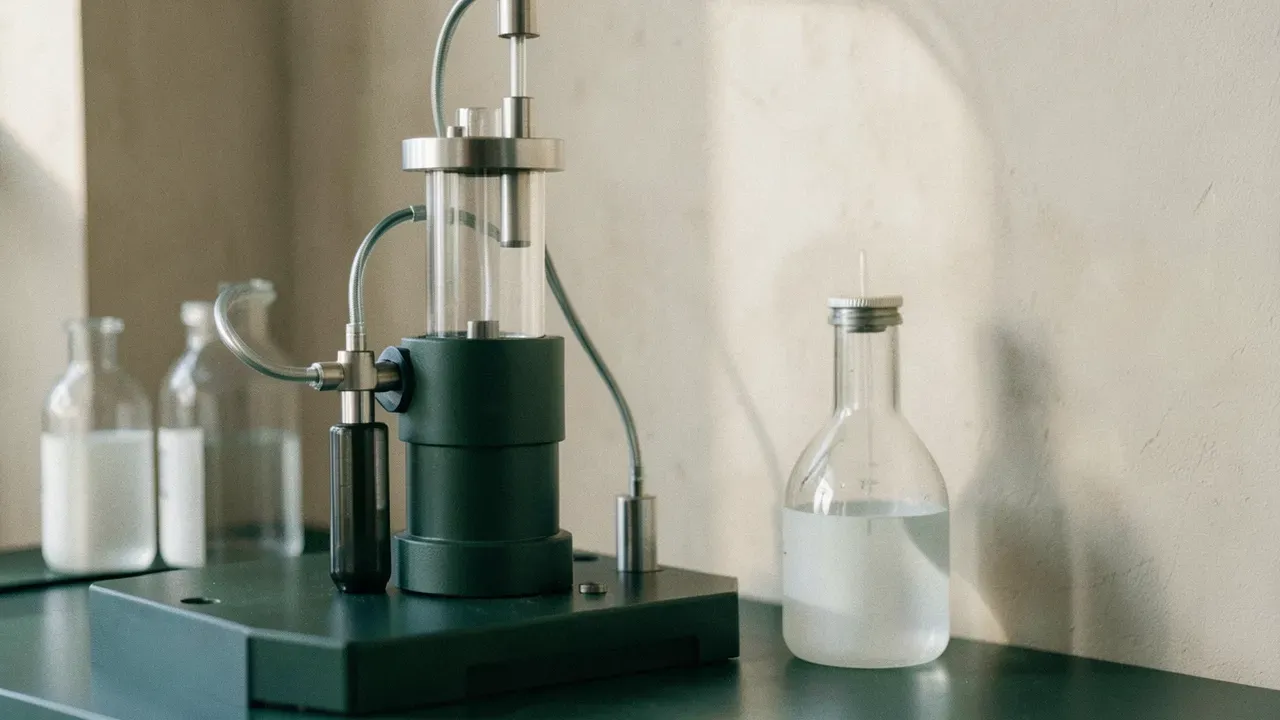
In HPLC (High-Performance Liquid Chromatography), a sample is dissolved and pushed through a column under high pressure. Components are retained to different degrees on the stationary phase, so they reach the detector at different times.
The result is a chromatogram: a graph in which each peak represents a component and the area under it is proportional to quantity.
How is a chromatogram read?
- The main peak should be the expected peptide.
- Smaller peaks before or after the main peak are impurities.
- Retention time helps with identification when compared with a standard.
- Resolution indicates whether the peaks are sufficiently separated for reliable integration.
- Peak shape (symmetry, tailing) can indicate problems with the column or the sample.
Purity is often calculated as the main peak area divided by the total area of all peaks, multiplied by 100.
Why is the percentage not the absolute truth?
- The detector does not see everything. A UV detector at 214 nm detects peptide bonds, but not all possible impurities equally well.
- Hidden impurities. Components that do not absorb or that elute together with the main peak are not separated.
- Integration is subjective. Where a peak begins and ends is decided by the software or analyst.
- The method determines the result. A different column and gradient can show a different picture.
The figure “99 %” is therefore meaningful only with the method and the chromatogram.
Mass spectrometry: identity
MS measures the mass-to-charge ratio (m/z) of ionised molecules. From this, the molecular mass can be calculated and compared with the expected value.
For peptides, MS is crucial because it:
- confirms that the main component corresponds to the desired sequence;
- can reveal modifications (acetylation, amidation, oxidation);
- helps distinguish between similar fragments;
- detects substitutions with another analogue.
What does “MS matches” mean?
This can mean very little or a great deal, depending on the documentation. A credible result states:
- the ionisation used (e.g. ESI);
- the mode (positive/negative);
- the measured mass;
- the expected mass;
- any fragments.
Without figures, “matches” is an unprovable claim.
What does a validated method mean?
Validation demonstrates that a method consistently measures what it claims to measure. For peptides, the following are important:
- specificity — whether the method distinguishes the peptide from related fragments;
- linearity — whether the response is proportional to concentration;
- accuracy and repeatability — whether results are stable across repetitions;
- limit of detection and quantification — the smallest reliable quantity;
- robustness — whether small changes in conditions affect the result.
When a supplier states a “validated method”, ask who performed the validation and where the data are. The word alone is not proof.
Water and salt content
Two frequently overlooked variables:
Water
A lyophilised powder is not necessarily dry. Residual moisture reduces the proportion of peptide per unit mass. If you prepare a solution of precise concentration, the water figure matters; to calculate concentration and volume use the peptide calculator, and for molar concentration and dilution the laboratory converter.
Salts
Peptides are often in the form of salts (e.g. acetate or trifluoroacetate). The salt increases the mass, but not the amount of peptide. For calculations, the peptide content must therefore be taken into account, not just total powder mass.
A good specification distinguishes:
- the total mass of the vial;
- the mass of peptide (as base or salt);
- the water content;
- the purity by HPLC.
What does all this mean for research?
For reproducibility:
- Use the same batch throughout, where possible.
- Record the batch number and the date of reconstitution.
- Calculate concentration from the actual content, not just nominal mass.
- Store the sample according to the protocol.
- Consider possible adsorption to plastic and stability in solution.
Red flags in analytical reports
- purity without a chromatogram;
- MS without a measured mass;
- the same analysis for several batches;
- lack of data on water and salts;
- incomprehensible units or an unclear method;
- an analysis date before the production date.
Read more in the guide to the certificate of analysis.
Conclusion
HPLC and MS are complementary methods: the first assesses how much of what is in the sample, the second confirms what the main component is. Neither is a magic wand. Peptide quality is a combination of analysis, traceability and honest reporting.
To understand how to use this when choosing a supplier, read How to recognise counterfeit peptides.
Frequently asked questions about this topic
Does 99 % purity mean the product is safe?
Why are both HPLC and MS needed?
What does water content in a lyophilisate mean?
How to cite
RuskiPeptidi Editorial Team. (2026). HPLC and mass spectrometry: peptide purity. RuskiPeptidi.com. https://ruskipeptidi.com/blog/hplc-mass-spectrometry-purity/
Editorial policy
The content is reviewed and sourced. If you find an error, let us know — we will publish a correction.
How we prepare contentSources
RuskiPeptidi Editorial Team
Content is prepared by the RuskiPeptidi.com editorial team based on primary scientific sources, regulatory documents and manufacturer data. Every article is reviewed before publication, and sources are listed at the end of the text.
Editorial policy and sources